
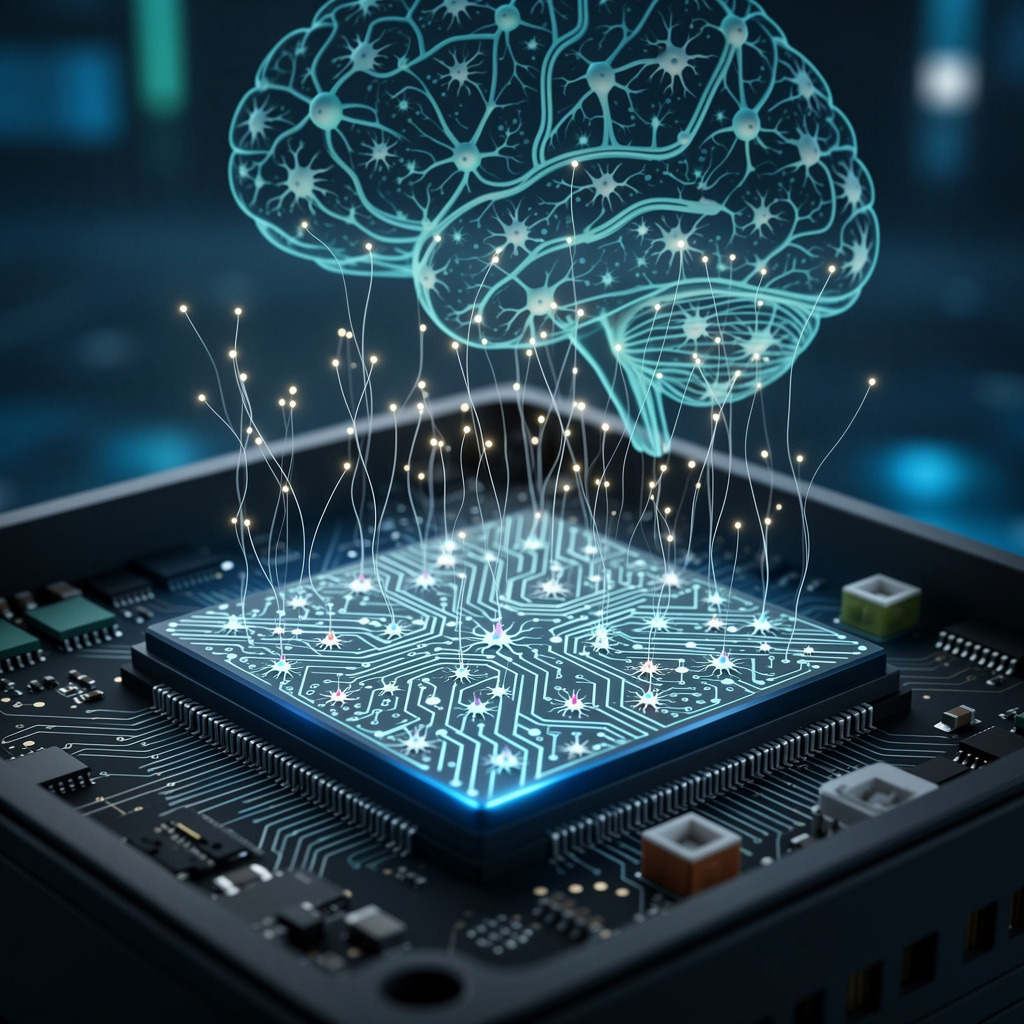
AI increasingly runs on devices with strict limits on power, size, and cooling. GPUs and neural processing units (NPUs) accelerate many workloads, but they are not always ideal for systems that must respond continuously to streams of events. Neuromorphic computing explores a different hardware and software approach inspired by some principles of biological neural systems. For selected workloads, it aims to process information in parallel and reduce unnecessary activity when little is changing.
What Is Neuromorphic Computing?
Neuromorphic computing refers to hardware and software designs inspired by the way neurons and synapses communicate. The goal is not to reproduce the human brain, but to explore alternative ways of organising computation, memory, and communication for particular tasks.
Many neuromorphic systems use spiking neural networks (SNNs). Instead of continuously sending activation values at every step, neuron-like units emit short signals, or spikes, when certain conditions are met. Information may be represented through timing, patterns, and spike frequency. When activity is sparse, parts of the system may perform less work while nothing relevant is happening.
How the Architecture Works
Event-Based Processing
Consider a sensor that monitors movement. An event-based system can process meaningful changes without treating every time interval as a complete image frame. This can suit time-dependent data, although the benefit depends on the sensor, model, and encoding method.
Parallel Units and Sparse Activity
Artificial neurons can maintain an internal state, accumulate inputs, and emit a spike when a threshold is reached. Many units may operate in parallel, while inactive connections can require fewer operations than a network that continuously calculates every value. Energy savings are not automatic: data encoding, inter-chip communication, and supporting circuits also consume power.
Memory Near Computation
Moving data between memory and processing units can cost time and energy. Some neuromorphic designs place neuron state and connection information close to the compute elements. Architectures vary widely, so “neuromorphic” describes a family of approaches rather than one standard chip design.
How It Differs from GPUs and NPUs
GPUs are effective at large parallel workloads, especially operations organised as tensors. NPUs are commonly designed to accelerate neural-network operations efficiently on a particular device. Neuromorphic hardware instead explores event timing and sparse activity for selected workloads. It is not automatically faster or more energy-efficient than a GPU or NPU; conventional accelerators may remain better for dense matrix operations and large generative models.
For a comparison of conventional AI accelerators, see our guide to the roles of CPUs, GPUs, and NPUs in AI PCs.
Potential Applications
- Robotics and autonomous systems: process changing sensor input with low latency, such as motion or obstacles.
- Edge devices: monitor an environment without continuously sending all raw data to a remote server.
- Audio and signal processing: analyse temporal patterns for speech or event detection.
- Adaptive-learning research: explore updating models as new data arrives, depending on the algorithms and hardware support.
Many examples remain research-focused. Intel’s Hala Point system, built using Loihi 2 processors, explores spiking neural networks and asynchronous processing. Reported efficiency depends on the workload and test conditions; it should not be interpreted as a guarantee that every AI application will achieve the same results.
Limitations and Development Challenges
A major challenge is the software ecosystem. A model trained for a GPU may not transfer directly to neuromorphic hardware with identical results. Developers may need to change data representations, train or adapt networks, and re-evaluate accuracy and stability. Tooling, documentation, production support, and hardware availability are also less mature than the CPU and GPU ecosystems.
How to Evaluate Efficiency Claims
- Check whether the benchmark uses a workload suited to event-based processing.
- Compare accuracy at equivalent quality levels.
- Find out whether energy measurements include sensors, memory, communication, and host systems.
- Distinguish single-event latency from sustained throughput.
- Review software tools, debugging support, and deployment readiness.
Conclusion
Neuromorphic computing offers an alternative for AI tasks that depend on timing, events, and sparse activity. Its practical value is most plausible when hardware, data, and algorithms are designed together for a specific workload. It is not a general replacement for GPUs or NPUs; real-world benefits must be demonstrated through fair tests and mature software support. Read more in Intel’s overview of Hala Point.
Leave a comment