
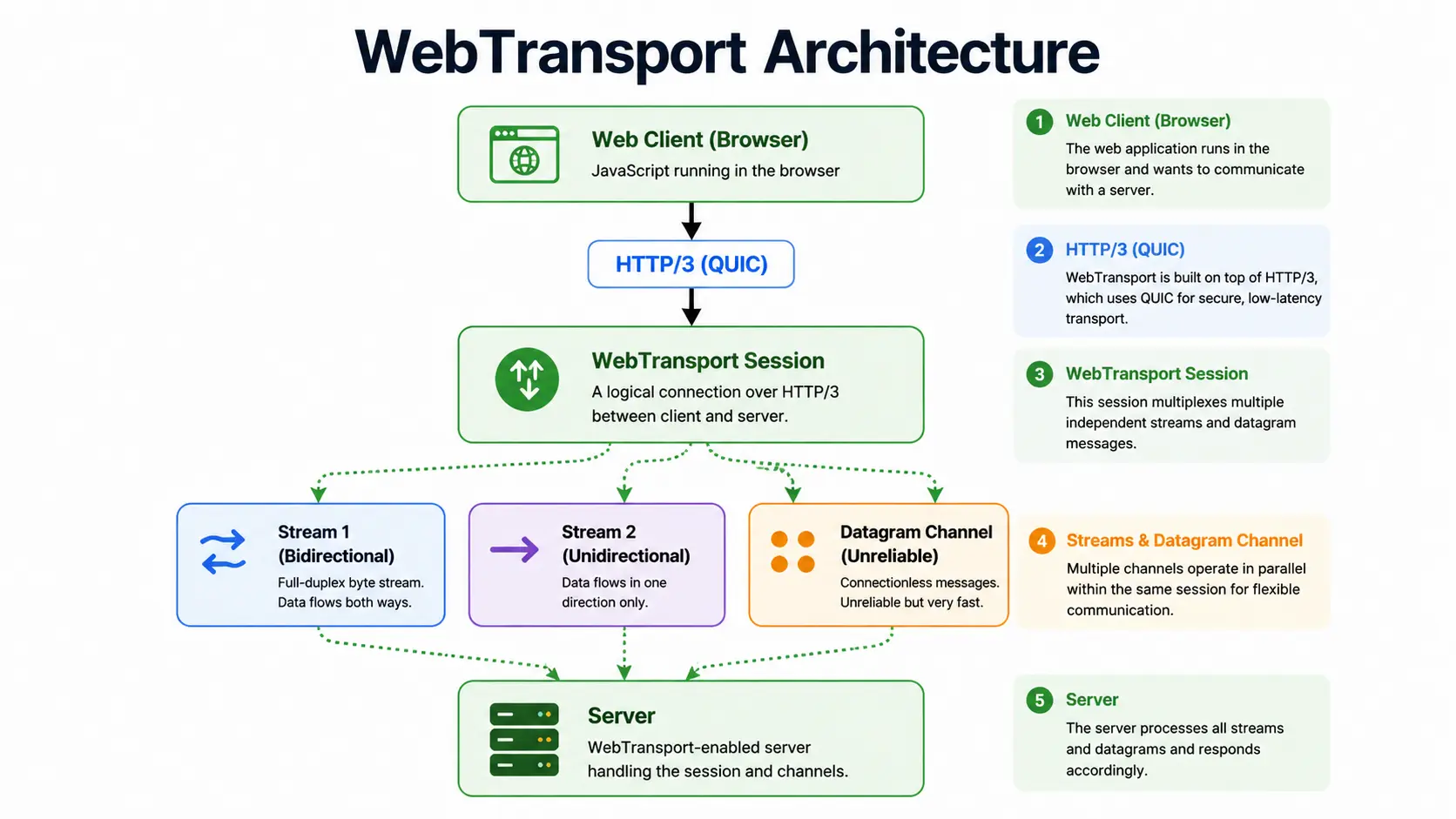
Modern web applications often require two-way communication without reloading the page. Chat apps, monitoring dashboards, live collaboration tools, and browser-based games all need rapid updates between client and server. WebSocket has long been the standard choice, while WebTransport offers a more flexible communication model through HTTP/3 and QUIC.
The two are not interchangeable in every situation. The best choice depends on the type of data, tolerance for packet loss, browser and server support, and your team’s ability to operate the infrastructure.
What Is WebSocket?
WebSocket provides a persistent two-way connection. After an initial handshake over HTTP, the browser and server can exchange messages through the same connection without creating new HTTP requests for each message. This model suits chat, notifications, order status, presence indicators, and dashboards that need periodic updates.
WebSocket’s strength lies in its mature ecosystem and broad support across programming languages, frameworks, hosting platforms, and monitoring tools. WebSocket typically runs over TCP, which delivers data reliably and in order. However, when a packet is lost, subsequent data on the connection may stall until the missing data is recovered.
What Is WebTransport?
WebTransport is a browser API for client-server communication over HTTP/3 on top of QUIC. The API supports bidirectional streams, unidirectional streams, and datagrams. Developers can choose the delivery mechanism that fits each data type’s requirements.
WebTransport streams provide reliable, ordered delivery within that stream. Multiple streams can run independently, so a delay on one stream does not necessarily block progress on others. Datagrams are intended for data that does not need guaranteed delivery or ordering—such as player position updates in a game that are quickly superseded by newer values. Do not use datagrams for transactions or commands that must be received.
Key Differences
- Communication model: WebSocket sends bidirectional messages through one persistent connection; WebTransport supports multiple streams and datagrams.
- Transport layer: WebSocket typically uses TCP, while WebTransport uses HTTP/3 and QUIC.
- Reliability: WebSocket delivers data reliably and in order; WebTransport offers reliable streams as well as datagrams that may be lost.
- Flow isolation: WebTransport streams can run independently, whereas WebSocket data shares a single sequential byte stream.
- Compatibility: WebSocket is widely supported and recognized by much infrastructure. WebTransport requires appropriate browser, server, and network path support.
When to Choose WebSocket?
Choose WebSocket when your application needs reliable two-way message exchange, simple data patterns, and broad compatibility. WebSocket also makes sense if your existing system is stable, your team is experienced in managing it, and measurements show that latency and capacity already meet your targets.
For chat, notifications, order status, or simple collaboration, the added benefits of WebTransport may not justify the complexity of a new implementation. Replacing a protocol simply because newer technology exists can add testing costs without improving user experience.
When Is WebTransport Worth Considering?
WebTransport is worth testing when your application needs independent streams, a mix of reliable data and datagrams, or finer-grained control over real-time traffic. Examples include browser games, interactive simulations, high-frequency monitoring, and applications sending updates that quickly become stale.
Before deploying, check your audience’s browser support, server libraries, HTTP/3 configuration, TLS termination, and the behavior of corporate proxies and networks. Do not assume that all CDNs, load balancers, firewalls, or hosting services support the required configuration. Prepare a fallback for browsers that do not support WebTransport or when connections fail to establish.
Steps Before Migration
- Measure baseline conditions. Record latency, concurrent connection counts, CPU usage, update frequency, and connection drop events.
- Categorize your data. Separate information that must be received from updates that can be lost because they will soon be replaced.
- Build a small prototype. Test WebTransport on the flows most likely to benefit and compare against WebSocket using the same scenarios and load.
- Design for recovery. Handle authentication, retries, message size limits, network changes, and dropped connections.
- Test real-world conditions. Simulate slow networks, high latency, packet loss, mobile network handoffs, and traffic spikes. Evaluate server costs and debugging ease.
Security and Operations
Both technologies require proper authentication, authorization, input validation, rate limiting, and session management. Use secure connections, restrict origins according to your application design, and check permissions for every action on the server. Encryption protects data in transit but does not prevent endpoint abuse by connected users.
Monitor active session counts, latency, data sizes, handshake failures, and reasons for connection closure. Avoid logging sensitive message contents without clear need. Set resource limits so that misbehaving clients cannot exhaust server capacity.
Conclusion
WebSocket remains practical for simple, reliable real-time communication that requires broad support. WebTransport offers more flexible streams and datagrams, but demands compatibility checks, infrastructure readiness, fallback planning, and monitoring.
Start from real needs, not protocol novelty. If WebSocket already meets your targets, keeping it is a reasonable choice. If measurements show bottlenecks that independent streams or datagrams could address, prototype WebTransport and compare results before committing to migration.
Leave a comment